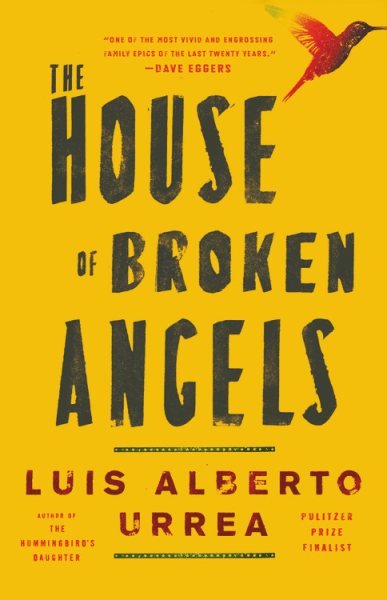
On May 7, Books on Tap met to discuss The House of Broken Angels by Luis Alberto Urrea. Urrea was born in Tijuana, Mexico in 1955 and is listed as an American born overseas. His family moved to San Diego, and eventually the suburb of Clairemont. His father was killed on a trip back to Mexico. Urrea’s mother encouraged him to write. His first novel, In Search of Snow, was published in 1994. The House of Broken Angels, based in part on the death of his older brother, was published in 2018.
A number of attendees loved the book. Some really liked it in audio. But others found the audio hard to follow as it jumped between characters. The book takes place over three days, but during that time the main character, Big Angel, is reflecting on his life. So there’s constant looking back. This bouncing around made it difficult for some readers to follow the story. There are also a lot of characters in this extended family. The paperback edition has a family tree. Those who read the story in hardcover said they really wanted that family tree! After all, the character Little Angel needed a notebook to keep track of everyone.
One aspect of the book that struck a number of readers was its strong sense of place. But this didn’t cause a problem for readers unfamiliar with the location because the novel explores more universal themes. Family is family, and the loves, hates, and turmoil are not unique to this culture or geographic area. One participant contrasted the family in this book with the Bundren family in Faulkner’s As I Lay Dying, which the group had discussed in September. The De La Cruz family is alive, fun, and funny. One reader found the reference to the slipper, or chancla, funny, while another pointed out that the chancla as threat of punishment is an integral part of the culture.
The extended family is huge and the names get confusing for the reader. Towards the end of the book, Little Angel crawls into bed with Big Angel to talk and share memories as brothers. Later, the core of the family joins Little Angel in the bed. When Yndio, Big Angel’s stepson who has been estranged from the family, is convinced to join the rest of the family on the bed, it is a sign that he has been brought back into the family.
Another major theme of the book is border culture and immigration. The author does not take a political position, but instead explores the experiences of the individual characters. The story thus becomes a broader border story, as applicable to somewhere like El Paso/Juarez as it is to San Diego/Tijuana. The overriding message here is that citizenship is complicated. The border is complicated.
While this book explored issues of masculinity in ways that made some male characters’ actions and attitudes offensive, it also explored ideas of aging and femininity. It was telling to some readers that Little Angel refused the mantle of next patriarch and said that Minnie, Big Angel’s devoted daughter, was the next patriarch, recognizing that she was already filling that role and validating her authority. In the end, Big Angel savors his history and his family, making the most of every moment he had left.
Other books by Urrea:
- In Search of Snow
- Queen of America
- The Hummingbird’s Daughter – John recommends this one. It’s more historical but fantastic. Like “100 Years of Solitude” but better.
- Into the Beautiful North
Other books mentioned:
- 100 Years of Solitude by Gabriel Garcia Marquez
- The Godfather by Mario Puzo
- As I Lay Dying by William Faulkner
- The Joy Luck Club – by Amy Tan; a different take on family and immigration.
Upcoming title:
June 4 : Starling House by Alix E. Harrow