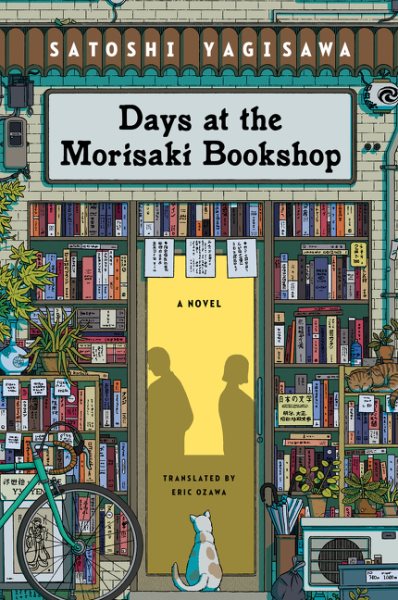
Central Library Brown Baggers discussed “Days at the Morisaki Bookshop” by Satoshi Yagisawa on April 16th. First published in Japan in 2010, the English translation was released in 2023. Set in the real life booktown of Jimocho, outside of Tokyo,Japan, the novel follows a young woman as she relocates to live above the Morisaki bookshop, owned by her uncle. Twenty-five year old Takako hasn’t seen her uncle for 10 years when he offers to have her come and work with him after she suffers a breakup and quits her job. As she gets to know her uncle, his customers and the local community, she also starts to read and comes out of her depression. Reading and working in the bookshop enlarges her mental community.
In the 2nd part of the story, Takako goes on a trip with her Aunt Momoko and learns why her aunt had abandoned her uncle and the bookshop for five years. One of our readers said the book reads like two short stories with the 2nd story added at the publisher’s request.
A few of our readers read “More Days at the Morisaki Bookshop” before reading the selected title. 🙂
Did the translation affect our readers’ enjoyment of the book? Readers found the writing dry, unoriginal and full of cliches. How much is lost in translation? Readers noted a universal problem with translation capturing the nuances of language.
There is the theme of love of books throughout the first story and how used books are a connection to previous readers, with underlined sections, notes in the margins, thoughts of the previous readers. “It’s only in secondhand books that you can savor encounters like this, connections that transcend time.”
One reader said the book was too sentimental yet he likes it for that reason. It has a quiet tenderness. The book grows on you, no plot, nothing really happening but it gets better in the 2nd part.
There has been a surge in popularity lately for novels by Japanese authors in translation, mostly with cats on the cover. 🙂 See the list below. Are they popular because they are short, light reads suitable for a commute? Do they provide a glimpse into Japanese culture or more of a stereotype?
We discussed how bookstores can have personalities. Charlottesville has several used bookstores. Would you say they each have their own niche and personality?
Other titles mentioned:
- 2010 “Days at the Morisaki Bookshop film
- More Days at the Morisaki Bookshop by Yagisawa
- The Woman in the Dunes by Kobo Abe – (read by Brown Baggers Feb. 2020)
- Never Let Me Go by Kazuo Ishiguro
- The Sailor Who Fell from Grace by Yukio Mishima
- The No No Boy by John Okada
- Margo’s Got Money Troubles by Rufi Thorpe
Recent Japanese novels in translation:
- The Full Moon Coffee Shop by Mai Mochizuki
- We’ll Prescribe You a Cat by Syou Ishida
- Before the Coffee Gets Cold series by Toshikazu Kawaguchi
- Goodnight Tokyo by Atsuhiro Yoshida
- The Blanket Cats by Kiyochi Shigematsu
- The Cat Who Saved Books and The Cat Who Saved the Library, both by Sosuke Natsukawa
- The Curious Kitten At the Chibineko Kitchen by Yuta Takahashi
- Kitchen by Banana Yoshimoto
- What You Are Looking for is in the Library by Michiko Aoyama
More about the booktown of Jimbocho, Japan
Upcoming Brown Baggers dates and titles:
- May 21st. The Boys from Brazil by Ira Levin
- June 18, 2026 The Wind Knows My Name by Isabel Allende
- July 16, 2026 Ficciones by Jorge Luis Borges