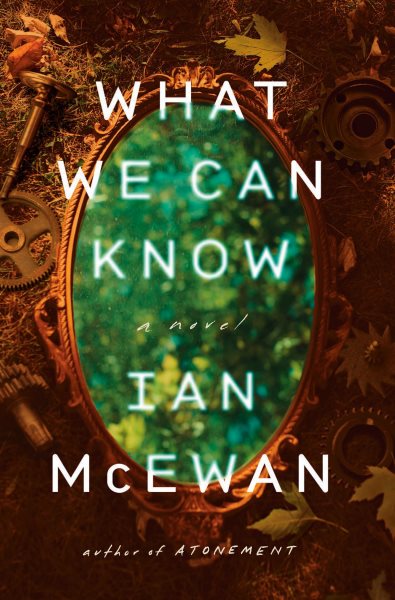
On August 6, Books on Tap met to discuss What We Can Know by Ian McEwan. Born in England, McEwan is a celebrated British author. What We Can Know, published in 2025, is a dystopian novel set in 2119. The story follows Thomas Metcalfe, a professor of the history and literature of the 20th and early 21st centuries, who is obsessed with a dinner party that took place in 2014 and the literary figures who attended that dinner.
Tom scours electronic records as well as print, sifting through emails, text messages, and social media postings. He is certain he knows these people and can recreate events of their lives. At the dinner, poet Francis Blundy read a poem he wrote for his wife, Vivien’s birthday, a poem that has gone missing. Tom desperately hopes to track down the missing masterpiece while idealizing Vivien. One reader really liked the way the dinner party acted as a frame for the narrative, with the 2014 party, called the Second Immortal Dinner, references to the original First Immortal Dinner in 1817, and the storyline of Tom trying to recreate the 2014 party.
Opinions on the book were decidedly mixed, leading to some lively discussion. While the person who suggested the book to the group could not attend, Krista shared some of the things that made them recommend it. They found the structure and storytelling remarkable and enjoyed the way the author switched back and forth between times and the contrast between what Tom could find, the story he recreates, and the facts revealed in the diary in Part 2.
Several readers found Tom unlikeable. Others descriptions were nasty and a jerk. He thought he was “all that,” but didn’t really know anything. But those who finished the book encouraged others to persevere because the second part brought it all together. One person described the first part as all telling with no showing. Another thought it read like a textbook. Still others found it interesting to get into the mind of the researcher.
One reader pointed out that Tom has some very specific blind spots, like completely ignoring the number from Vivien’s diary that was pointed out by a librarian. It was such key information for his search, but if he hadn’t ignored it, most of the first part would not have happened. He is so obsessed with chasing the past, that he ignores the present. The last sentence of the first part was telling for some. After searching so hard for the poem, they open the box, only to discover, “It’s prose!”
Part 2 is actually Vivien’s diary and shows her to be a much more complex person than Tom realized. Readers felt that the description of Vivien’s journey as a caregiver for her failing husband, Percy, was very raw and real. It makes her a much more sympathetic character. Another pointed out that at first, she seemed really downtrodden living with Francis. But reading the diary, it becomes clear that she sought it out. Other episodes in her life definitely dispelled Tom’s idealized view of her. One reader commented on the promiscuity while another noted that it was no wonder they didn’t do anything about climate change; they had too much drama going on in their lives. “So much blackmail,” was one summary of the events in the diary.
While the dinner party served as a frame for the book, some thought that Francis and the poem were actually the main characters of the book. Over time, the poem took on a life of its own. Because it was missing, people could project whatever meaning suited them onto the poem.
Some readers found the description of a dystopian future compelling. It felt real and like it could actually happen. Others thought that there was so much apocalyptic description that it was if the author was enjoying criticizing us. Another thought that with so many issues described, the discussion remained shallow. One interesting point was that while the rare form of the missing poem was called a Corona, there was absolutely no mention of the Corona virus. Someone commented that they have often wondered what a future curriculum of our time period would look like? How will people see us in the future?
Reactions to the book were pretty evenly split, with some loving it, some liking it, and some strongly disliking. It was definitely a book that some would never have read if not for book group, which, afterall, is the point of a book group.
Other books by McEwan:
- Atonement (2001), made into a film in 2007
- The Child in Time (1987)
- Solar (2010)
Other books mentioned:
- Thérèse Raquin by Emile Zola
Upcoming Books on Tap dates and titles:
- Sept. 3rd : Book Lovers by Emily Henry
- Oct 1st : Dead Wake: The Last Crossing of the Lusitania by Eric Larson
- Nov 5th: Raising Hare: A Memoir by Chloe Dalton
- Dec 3rd : Things We Never Say by Elizabeth Strout