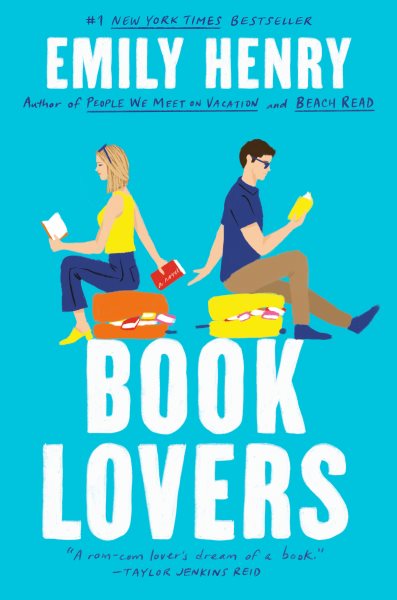
On September 3, Books on Tap met to discuss Book Lovers by Emily Henry. The group had read Henry’s book, People We Meet on Vacation last summer. While opinions were mixed, as usual, most agreed it was nice to have an easy read, a beach read, to end the summer.
The group includes several die-hard Emily Henry fans, most of whom thought this was the best book by Henry. Several others, who aren’t usually fans of romance, agreed that this book was definitely better than last summer’s.
Henry’s first five books have been adapted for the screen. Some readers felt like this book was written to be produced, that it read like a script. One reader thought it will be great on screen. Another felt like it was just a stream of consciousness narrative that was very predictable and felt formulaic. Yet another felt like there could have been more character development, that they knew what was going to happen as soon as Charlie was in the coffee line. One reader was put off by the way the characters interacted, that it seemed very like a cliche of New Yorkers. Others compared it to a made-for-TV Hallmark movie.
In addition to being a rom-com, most agreed that this is also a sister story. Yet several thought it didn’t reflect realistic sister relationships based on their experiences. Still the relationship between the sisters generated a lot of discussion. Nora tries to control and take responsibility for everything in their relationship, to which Libby responds, “You are not my father!” Nora idealized her mom and how her mom lived, while Libby was more removed and saw that it really wasn’t great. But Nora is always trying to cut off the pain rather than face the trauma of her past. This sibling relationship had readers wondering about Emily Henry’s birth order and siblings. (Henry is the youngest child with two older brothers.)
One important theme was the different ways the sisters reacted to small-town life. Libby saw it as a chance to reinvent herself, try something new. But Nora never let herself fully experience it. One reader thought Nora was a New York person through and through and refused to let that part of her identity go. She also focused on continuing her mom’s heritage and lifestyle. Libby wanted something different. She needed to break away. One annoying trait of Nora was her sense of martyrdom, giving everything up for Libby’s benefit when Libby didn’t want that, and then Nora expects Libby to feel bad about it.
While many agreed that this was primarily a light, rom-com, others were disappointed that Henry did not explore multiple other themes that would have added complexity to the story. One reader felt strongly that Henry should have developed the Mother-Sister trauma more. Nora clearly didn’t recognize how badly the trauma of her mother’s death affected her. Another found it frustrating that the book kept referring to Nora’s traumatic romantic history, but felt let down when it was finally revealed. One said that Nora was living through her little sister, completely unaware of how much pain she herself was in and how much pain she was inflicting on others around her.
Because the book focuses on the romance of people heavily involved in the book publishing business, it was inevitable that the discussion turned to books, reading them, promoting them, and editing them. If nothing else, some readers found it a bit meta, a rom-com making fun of rom-coms.
Nora likes to read the last page of a book first, while Libby prefers to dive in with as little advance knowledge about the book as possible. The group discussed the different ways they read books, with some feeling like you just need a warning to prepare you if things are going to go wrong, while others steadfastly read from beginning to end avoiding spoilers.
The group also discussed the process of editing and how important it really was to books. One reader pointed out examples of authors who became successful and were allowed to publish without careful editing, only to have their books balloon to 600 pages with multiple, distracting repetitions of phrases and descriptions. The conclusion was that a good editor can make a book, and a smart author listens to the editor. But there was some disagreement about whether Nora and Charlie could really work together to co-edit the book, and whether Nora could so easily transition from the role of author’s agent to editor.
While opinions were mixed on whether Nora and Charlie’s relationship would last, most believed they would definitely get a cat.
Other books by Emily Henry:
Other books mentioned:
- Whistler by Ann Patchett
- Pride and Prejudice mentioned in a review of Book Lovers
- Wuthering Heights Henry references Heathcliff in Book Lovers
Upcoming titles:
- Oct 1st : Dead Wake: The Last Crossing of the Lusitania by Erik Larson
- Nov 5th: Raising Hare: A Memoir by Chloe Dalton
- Dec 3rd : Things We Never Say by Elizabeth Strout