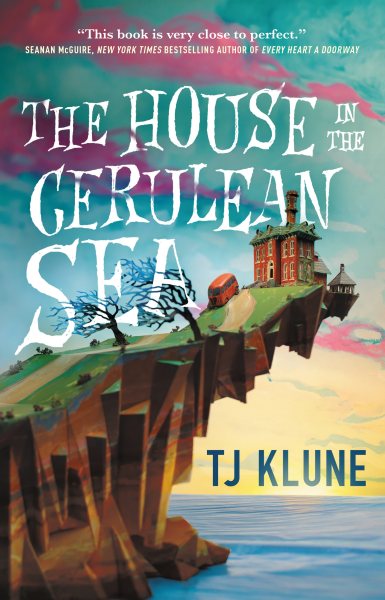
On November 6, Books on Tap met to discuss The House in the Cerulean Sea by T.J. Klune. Klune is an American author whose books feature LGBTQIA+ characters. He won a Lambda Award in 2014 for Into This River I Drown. He started writing at the age of 8 and was influenced by Stephen King, Wilson Rawls, and Terry Pratchett. Several readers picked up on a British sense of humor and turn of phrase throughout the book. Others saw a parallel with Harry Potter, especially the term “extremely upper management,” a term many really enjoyed.
The book’s themes struck some as particularly timely and included the idea that one person can make a difference, small steps count, and a focus on found family. Another major theme was accepting differences, asking not what people are, but who they are. Looking past labels. Klune reported being partially inspired to write this book in response to the Canadian Government’s history of removing Indigenous children to residential schools, something that also took place in the United States.
Yet the book still struck readers as cozy, lighter, and even joyful. There is LGBTQIA+ romance, but it is very low key. At least one reader likened it to a beach read since it takes place at the bright, sunny beach just as summer is ending, in contrast with Linus’ home in the city where it rains endlessly. One attendee saw a parallel with the movie, The Wizard of Oz, where the film starts out in black and white and becomes colorful in Oz.
One reader said the book felt like it might be YA because it ties everything up so neatly at the end. Another person enjoyed it but found it predictable. One reader was worn out by the fantasy and felt that the book could have been written without the fantasy. This comment sparked a lively discussion of why the book was written the way it was.
Another reader pointed out that this book without the fantasy has already been written many times. Others felt that without the fantasy, it would have been heavier and a harder read. It made important concepts interesting and palatable. It might appeal to adults who wouldn’t normally read a book about these themes. It has a very happy cover and the inside matches the outside.
The titular house is an orphanage for magical children situated on an island just offshore from a beach town. Linus is an inspector, sent from the city to be sure the children are being properly cared for. Each child has a different magical background and a very different personality. These are children who have nobody and have been shifted around repeatedly. They have no home because they don’t fit the mold. And they are hated and feared by the people of the town.
The group had a lively discussion of their favorite characters. One reader was drawn to Sal, the large boy who turned into a Pomeranian whenever he was frightened. Another was drawn to Talia, a rather prickly gnome who befriends a young girl through a store window. Even after the girl’s mother hustled her away, Talia commented that it was okay, the girl was her friend, clearly making the point that change starts with one person. Another enjoyed the character of Lucy, short for Lucifer, son of Satan. They said that you wanted to strangle him, but at the same time felt sorry for him. He can’t help who he is. The dark in him also harms him. Lucy was the source of one of the group’s favorite quotes, “My real dad knows a lot of personal injury lawyers.”
The larger-than-life nature of the characters prompted one attendee to compare it to the Hunger Games movie. Another thought the characters represented all the things we deal with on the inside and referenced the movie, Inside Out. We’ve all said of someone that we wanted to kill them. Only, Lucy actually could. But he’s tormented by that, has nightmares and is scared. Like Sal, we’re supposed to be brave, but we often want to just curl up and be the little dog. They represent personality characteristics.
The group discussed why this book had been challenged. The obvious first answer was for its LGBTQIA+ content. Some found it hard to believe that the salacious thing about the book was that there is a consensual, closed-door gay relationship. Yet Lucy is the literal antichrist. One reader pointed out that we had not even mentioned that until halfway through the meeting.
In the end, all agreed that while the book was light and feel-good, it was also thoughtful, dealing with important issues and ideas. The consensus was also that it was humorous and very quotable! So many quotes!
“Just because you don’t experience prejudice in your everyday life doesn’t stop it from existing for the rest of us.”
Other books by T. J. Klune:
- Somewhere Beyond the Sea (sequel to The House in the Cerulean Sea)
- Under the Whispering Door
Films mentioned:
Upcoming Books on Tap dates and titles:
- December 11 : The High Mountains of Portugal by Yann Martel
- January 8 : The River Is Waiting by Wally LambFebruary 5: Master Slave Husband Wife: An Epic Journey from Slavery to Freedom by Ilyon Woo