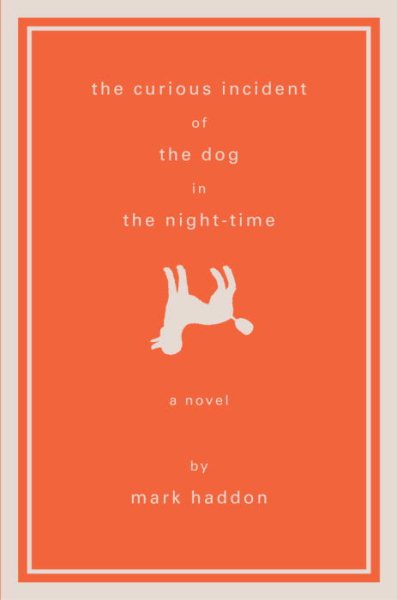
On October 2, Books on Tap met at Random Row Brewing to discuss the curious incident of the dog in the night-time by Mark Haddon. Haddon is an English novelist, best known for this book which was written for adults but it also greatly appeals to the young adult crowd. He won the Whitbread Award, the Dolly Gray Children’s Literature Award, the Guardian Prize, and a Commonwealth Writers’ Prize for the work. He has published other novels for adults and he has also written extensively for children. Other adult writing interests include short stories, poetry, and a play.
The novel’s main character is Christopher, a 15-year-old boy on the Autism spectrum, who replicates the methods of Sherlock Holmes to discover who killed his neighbor’s dog with a garden rake. The group generally liked the book and observed that Haddon presented Christopher’s spectrum disorder with a serious approach and was consistent throughout the course of the novel.
For many of our readers this was a first time read. Our readers found insight into the life of a person with Autism and were sympathetic to Christopher’s condition. Some felt empathy for the disorder; it was pointed out that Aspergers is similar, but milder than Autism.
Most everyone felt the humor with the police officers helped to lighten the tone of the story. One reader felt exhausted – because of the brutal killing of the dog by the dad and because they felt that while Haddon did a great job of being in the kids’ head, it was difficult to read about his constant challenges. While Christopher struggles with the death of his mother and Winston, the group felt that Christopher related more to animals than he did to people.
One second time reader liked it better this time. Some readers thought the London Underground scenes were tedious the second time around. Two members saw the play version. One at Live Arts, the other on Broadway. An actor with autism played Christopher in the live performance. In the play version Christopher never stopped moving or doing maths, so in that way, the live production exactly mirrored the actions of the main character in the novel. It was opted as a film but that never materialized.
Some argued that the novel is about being DIFFERENT – pointing out that no specific disorder is ever mentioned, however we all agreed that Christopher is most likely somewhere on the Autism spectrum. Haddon did work with autistic individuals in a previous career. While writing the book he said he did more research about the London Underground than he did about Autism.
The group felt it was genius that the book was totally written from the perspective of Christopher. Was he a truthful narrator? Yes. He was reliable and did not lie. Humor is so important in life yet he never understood it, leading some to find the novel very nuanced. Some people on the spectrum don’t understand sarcasm. One reader found it interesting that Christopher was so black and white in his thinking.
There were lots of math and science problems and several readers skimmed those parts. We were proud of ourselves for figuring out the chapters were numbered using prime numbers! One member listened to the audiobook and felt there was a void with the prime numbering of the chapters.
We all agreed that all of the adults in the book were disappointing. Especially the dad for telling Christopher that his mother was dead! Why on earth would he tell the child that? Some felt that was a crutch.
Mom seemed limited and overwhelmed. Why didn’t she investigate why Christopher wasn’t responding to her letters? We discussed hate vs. empathy for the parents. The dad definitely had more patience and empathy for Christopher than the mom did. When Christopher showed up on her doorstep she had completely forgotten how to handle him – hugging him and taking him shopping. We all agreed that it must be tough, tough, tough to parent a child with such special needs.
Is Christopher going to realize his dreams? Most readers felt that he most likely would.
One book group member worked with Autistic children and said that it is very emotionally challenging. It has been documented that there are increased diagnoses these days of people on the spectrum.
Pervasive Developmental Disorder Not Otherwise Specified (PDD-NOS) is a diagnosis that was previously used to describe individuals who exhibited some, but not all, of the symptoms characteristic of autism spectrum disorder (ASD). It is no longer used. The correct terminology to use today is Neurodiverse – a concept that variations in brain function and cognitive abilities are a natural part of human diversity, rather than a deficit or disability.
There are many references to Sherlock Holmes in the book and members pointed out that Christopehr approached the mystery of the dead dog in similar ways. The group feels that Sherlock Holmes would probably be diagnosed as being somewhere on the spectrum today. He has no social skills and is brilliant. Are we all somewhere on the spectrum?
Although the novel reached the top of The New York Times bestseller list for fiction, Haddon has been criticized for his depiction of people with autism or a similar disorder. It has been banned for profanity, religious viewpoint, and taking the Lord’s name in vain.
Other titles mentioned:
- Running with Scissors by Augusten Burroughs
- Rain Man movie
- Doll Maker by Richard Montanari
- Astrid on PBS
- Extraordinary Attorney Woo – Korean lawyer who loves whales; really cute
NPR has featured content related to Mark Haddon’s novel, the curious incident of the dog in the night-time, including author interviews, book excerpts, and NPR member station features.
Upcoming titles:
- December 11 * 2nd Thursday: The High Mountains of Portugal by Yann Martel
- January 8 * 2nd Thursday: The River Is Waiting by Wally Lamb
- February 5: Master Slave Husband Wife: An Epic Journey from Slavery to Freedom by Ilyon Woo